

Its Going to be AOC
Breaking down the 2028 Democratic Primary

Alexandria Ocasio-Cortez is positioning herself for a Presidential run in 2028, and barring any black swans, she will win.
The Congresswoman from the Bronx, founder of the Squad, and by far the most high profile young progressive in the country has long been touted among her fans as a dream candidate for 2028. Until very recently, this idea has been dismissed out of hand on the grounds that AOC’s popularity is limited to just the left wing of the Democratic party, or even just her own Congressional District. Some have even gone so far as to dismiss the idea that the United States is even capable of electing a woman to the Presidency, citing Hillary Clinton and Kamala Harris’ failed runs in recent years. But these have never been serious assessments of the Congresswoman’s electability, just vibes.
There are those who point out that AOC seldom clears single digits in polling among potential primary challengers, and that California Governor Gavin Newsom is a far more plausible candidate. This point seems reasonable, given Newsom’s enormous campaign war chest, well cultivated national profile, connection to an important and populous state, and more moderate politics that would appeal to a wider range of voters. But the same could be said of JEB Bush in 2016, and he didn’t win a single state.
So let’s attempt a serious analysis of Alexandria Ocasio-Cortez’s chances in 2028, beginning with the field of candidates in the Democratic primary. At of writing, Andy Beshear, Cory Booker, Pete Buttigieg, Rahm Emanuel, Josh Green, Kamala Harris, Mark Kelly, and Gavin Newsom have all expressed interest in running for President. There has been speculation that Phil Murphy, JB Pritzker, Josh Shapiro, Jon Stewart, Chris Van Hollen, Gretchen Whitmer, and AOC will eventually announce their intent to run as well. Now let’s get the obvious out of the way: many of these candidates are likely not serious about running for President, and are just using speculation to raise money for the party or the jobs they already hold, or to sell books. Corey Booker used this same strategy in 2020.
The only candidate I’m fairly certain who won’t run in 2028 is Kamala Harris. While Harris did release a book in 2025, a common tactic to raise a politician’s profile in advance of a run, she has made no moves to raise campaign dollars. Harris also hasn’t made many public appearances since the campaign. While this wouldn’t be unusual at this juncture for a potential Presidential Candidate, Kamala Harris is the former Vice President of the United States, and her party’s previous nominee. Frankly, its a lot weirder that she hasn’t kept campaigning. If If she did run, at this point Harris would be starting the primary with far fewer resources than she needs, and would risk an embarrassing defeat.
As for the other candidates, most are either too similar to their rivals, or not particularly well known.
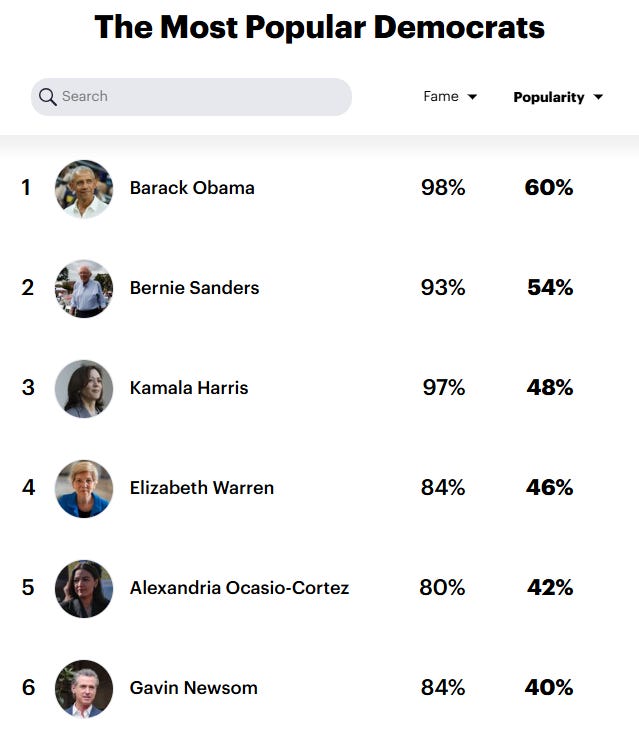
YouGov’s ranking of Democrats by popularity vs. fame paints a far different picture of electability than what gets speculated online or even by professional politicos. After Gavin Newsom, the fame and popularity the 2028 primary field starts to fall dramatically. Big donor money can help raise a profile, but it can’t make a politician more charismatic or seriously elevate an unimpressive record. And even if it could, we’ve already seen what happens when you have a crowded field of middle-weight politicians representing the old political center, and fueled primarily by big money donors.
In 2016 there were 12 Republican candidates during their party’s primary, and another 5 who withdrew before the Iowa Caucuses. None were particularly more well known or charismatic than their rivals. The most you could say about their careers was that they were either more moderate than the average Republican, or that they were good at getting re-elected. Then along came Donald Trump, a man so… distinct, from the rest of the pack that he was able to attract a large bloc voters that nobody was catering to. He was dismissed as a fringe candidate, wildly unpopular outside of the base of the party, and the other candidates were united in their opposition to him. But because he was so distinct, so well known, and his rival so similar and numerous, he picked up a string of plurality victories that gradually made him a serious candidate and drove out the rest of his rivals. Remember, Trump didn’t win a majority of the vote in one state until New York on April 19, at which point he was one of three candidates remaining.
Now, the Democrats are going into 2028 with a similar problem: a glut of candidates struggling to stand out vs. the one who actually does stand out. AOC comes into 2028 with a rabid fanbase, something no one could seriously claim is possessed by her rivals. The base of the party loves her on policy, she’s well known outside of the base, and has an impressive campaign war chest: ~$15 Million in 2024 or about 1.8 million more than Newsom raised in his 2022 reelection campaign. Not bad for someone who refuses to take big donor money. But she has two more advantages that Donald Trump nor any of her Democratic rivals don’t have: She is a representative of Millennials and Hispanic voters, two groups that are usually only given only the most half-hearted outreach from the Democratic party.
AOC has not only top tier Spanish Language outreach within her Congressional campaign staff, she has an online profile second only to Barack Obama and Bernie Sanders, and is far more adept at modern social media outreach. So when she runs, she’ll be able to tap into a sizable bloc of voters. Newsom is the only one with a comparable social media presence, but its mainly based on platforms like X and BlueSky, where AOC has a TikTok and Instagram following that is more effective at reaching younger voters. Newsom should have a good Spanish language outreach effort, especially given his hostility toward ICE, but he (like most California Democrats) tends to suffer in this area because he’s used to winning that voting bloc as a rule, relying on local politicians to drive turnout. And even if every candidate scrambles to stand up an office to communicate to Spanish-speakers, they simply won’t be able to do so as genuinely as someone who grew up speaking it with family and community.
AOC will have ample opportunities to distinguish herself before the Iowa Caucuses, particularly in the debates where the similarities between the other candidates’ positions will be on full display. But as ever, it will be in Iowa where she’ll truly stand out as the lone well-known progressive in a sea of moderates and nobodies. The media, just like they did in 2016, will focus all their energy trying to discredit a political outsider, forgetting that there’s no such thing as bad press, and thus raising her national profile. Newsom will bet everything on the California primary, where I’m confident he’ll be lucky to eek out a plurality victory that won’t translate to the rest of the country. And all of this ignores any outsized economic or social pressures on the electorate going into 2028, of which I’ve written about extensively.
Sean McKnight if he was YNot1969, and it was January 2006: It's going to be Obama (in all seriousness, I think it's simultaneously rather implausible, and yet one of the most likely scenarios to happen, which I guess is kinda similar to Obama 2008 in that respect)